
10 July 2026 Reading time: 3 min (721 words)
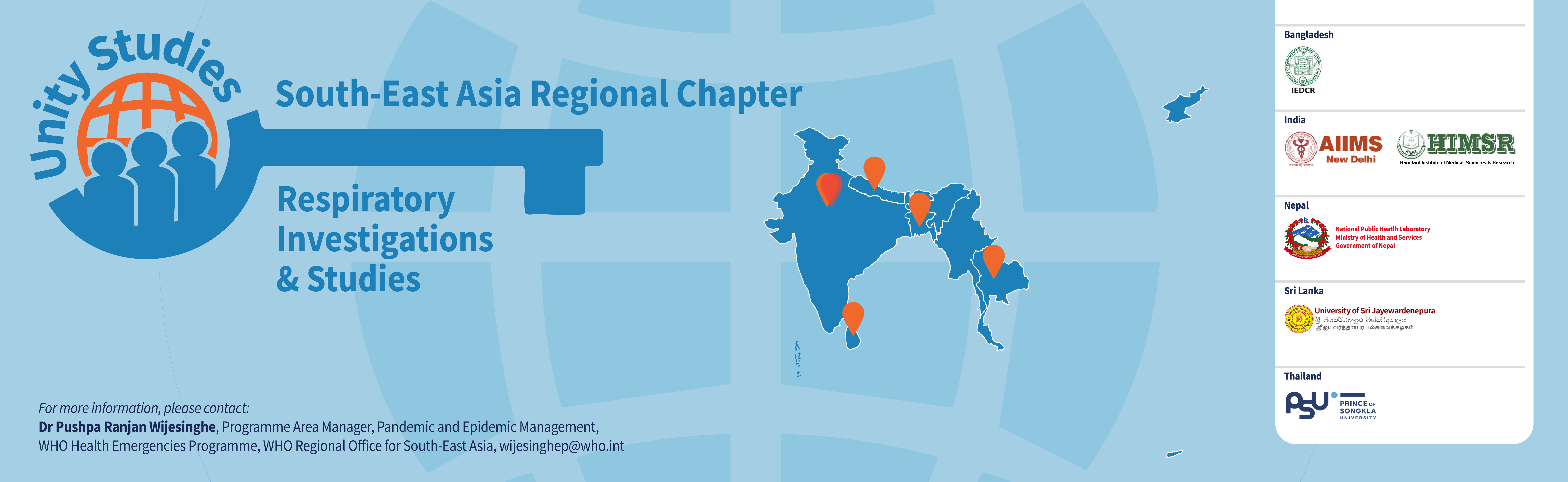
WHO GISRS Unity Studies Sites Network: South-East Asia Regional Chapter
Background
The WHO Investigations and Studies Initiative, commonly known as the Unity Studies serves as a global and regional mechanism to strengthen preparedness and readiness for emerging or re-emerging respiratory pathogens of pandemic and epidemic potential. It complements routine surveillance systems by enabling targeted, standardized epidemiological investigations to address key questions on transmission dynamics, disease severity, population susceptibility, and the effectiveness of public health and social measures. These studies are particularly valuable during the early stages of an outbreak and can also be applied on an ongoing or alert-driven basis, including in response to emerging respiratory virus variants.
Through standardized protocols and a coordinated network of global and regional implementation sites, the initiative supports the generation of timely, high-quality, and comparable evidence for public health action while strengthening operational research as a part of collaborative surveillance. To enable rapid implementation, key preconditions include ethically approved protocols, adequate resources, clearly defined roles and responsibilities, and robust data governance systems. Together, these elements ensure that countries and regions are equipped to rapidly implement targeted investigations and generate high quality scientific evidence to guide public health quality scientific evidence to guide public health decision making at national, regional, and global levels during epidemics and pandemics.
The Global Influenza Programme (GIP) at WHO Headquarters coordinates the network globally, while the WHO South-East Asia Region (SEAR) established its regional chapter in early 2024, and is coordinated by the Pandemic and Epidemic Management (PEM) unit at the WHO Regional Office for South-East Asia (SEARO).
Terms of Reference (ToR)
Unity Studies Network Sites operate under a global Terms of Reference (ToR), which has been adopted by South-East Asia Region to guide the establishment and operation of the network. The ToR outlines the roles and responsibilities of participating institutions, including implementing standardized epidemiological investigations, ensuring data quality, and contributing to collaborative research efforts. It also specifies the criteria for site selection, the benefits of participation such as access to technical guidance, training, and regional collaboration and the process through which interested institutions or entities can join this global initiative to strengthen pandemic preparedness.
The full Terms of Reference for Unity Studies Network Sites SEAR chapter can be accessed here.
SEAR Unity Studies Network Sites
By 2025, six sites across five countries in the South‑East Asia Region formally acknowledged the terms of reference, confirming their institutional commitment to the Unity Studies Network. Participating sites designated national focal points or principal investigators to coordinate activities with WHO. Table 1 below lists the Unity Studies sites in SEAR that formally acknowledged and joined the network by the end of 2025.
Table 1: Unity Studies Sites in SEAR with the focal points
| Member States | Name of Unity Studies Sites | Principal Investigators/Focal points |
|---|---|---|
| Bangladesh | Institute of Epidemiology Disease Control and Research (IEDCR), Dhaka | Prof Dr Tahmina Shirin Director, IEDCR Email: tahmina.shirin14@gmail.com |
| India | All India Institute of Medical Sciences (AIIMS), New Delhi | Dr Puneet Misra, Professor, Center for Community Medicine Email: doctormisra@gmail.com |
| Hamdard Institute of Medical Sciences & Research (HIMSR), New Delhi | Dr Farzana Islam, | |
| Nepal | National Public Health Laboratory (NPHL), Teku, Kathmandu | Dr Runa Jha, Director NPHL Email: director@nphl.gov.np Ms Lilee Shrestha, Chief Medical Technologist, NPHL Email: shresthalilee@gmail.com |
| Sri Lanka | University of Sri Jayewardenepura (USJ), Gangodawila, Nugegoda | Dr Neelika Malavige, Senior Professor, Department of Immunology and Molecular Medicine, USJ Email:neelika@sjp.ac.lk;neelikamalavige@gmail.com |
| Thailand | Prince of Songkla University (PSU), Songkhla | Prof. Dr. Tippawan Liabsuetrakul, Department of Epidemiology, Faculty of Medicine, PSU Email: ltippawa@hotmail.com |
Notably, in 2025, SEAR achieved the PIP PC HLIP III Monitoring and Evaluation Framework regional target of five sites joining the network by 2029, marking a significant milestone for the region, four years ahead of schedule. Most sites have also initiated country‑level activities, leveraging catalytic PIP PC funds alongside other available funding sources.
News
/epidemic-and-pandemic-preparedness-and-prevention-(epp)/influenza-preparedness-and-response-(ipr)/pip-story-gip-us.png?sfvrsn=4ceb4e65_1 "pip story GIP US")
Standardized Protocols
A series of standardized template protocols have been developed for influenza-specific investigations, and potentially for investigating other respiratory viruses of pandemic potential, for use at different stages of a pandemic course by the WHO.
Influenza template protocols can be accessed here:
SEAR Unity Studies Network: Annual Progress
Publications
Related links
Contact us
Dr Pushpa Ranjan Wijesinghe
Programme Area Manager, Pandemic and Epidemic Management
WHO Health Emergencies Programme
WHO Regional Office for South-East Asia
wijesinghep@who.int